
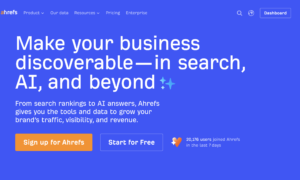

SEO in 2026 is more complex than before. Ranking on Google is still important, but brands now also need to think about AI search, content quality, backlinks, technical SEO, and competitor visibility.
That is why tools like Ahrefs are still popular. Ahrefs helps marketers research keywords, analyze backlinks, audit websites, track rankings, study competitors, and find content opportunities.
In this Ahrefs Review 2026, we will look at what Ahrefs does, its main features, pros and cons, how it compares with Semrush, and whether it is still worth using for SEO.
What Is Ahrefs?
Ahrefs is an SEO and digital marketing platform. It is mainly used for keyword research, backlink analysis, competitor research, site audits, rank tracking, and content research.
Many SEO professionals use Ahrefs because of its backlink database and keyword data. It helps users understand which websites are linking to competitors, which keywords are bringing traffic, and which pages are performing well in search.
Ahrefs is useful for freelancers, agencies, content marketers, affiliate site owners, SaaS companies, ecommerce brands, and in-house SEO teams.
Instead of guessing what to write or which links to build, Ahrefs gives data that can help guide SEO decisions.
Why Ahrefs Matters in 2026
SEO has changed a lot in 2026. Google results are more crowded, AI Overviews can reduce clicks for some searches, and users are also searching through tools like ChatGPT, Perplexity, and Gemini.
This means SEO teams need more than basic keyword data. They need to understand search demand, backlink strength, content gaps, technical issues, and how competitors are gaining visibility.
Ahrefs is useful because it brings many of these insights into one platform.
Statistics also show why SEO tools matter. Ahrefs found that 96.55% of pages get no organic traffic from Google. That means most content does not perform well in search. To compete, websites need better keyword targeting, stronger content, backlinks, and technical SEO.
Ahrefs also says its keyword database includes billions of keywords. In 2026, Ahrefs reported that its database included 28.7 billion keywords for its Google search data. This kind of data helps SEOs find topics, compare opportunities, and plan content more carefully.
Main Features of Ahrefs
Ahrefs has several tools, but its main features are Site Explorer, Keywords Explorer, Site Audit, Rank Tracker, and Content Explorer.
Site Explorer is one of the most popular features. It lets you analyze any website or URL. You can check backlinks, organic keywords, top pages, competing domains, referring domains, and traffic estimates.
Keywords Explorer helps you research keywords. You can check search volume, keyword difficulty, traffic potential, parent topics, related terms, and SERP results. This is useful when planning blog posts, service pages, product pages, and content clusters.
Site Audit helps find technical SEO problems. It crawls your website and reports issues such as broken links, missing tags, slow pages, redirect problems, duplicate content, and crawlability issues.
Rank Tracker helps you monitor keyword rankings over time. This is useful for seeing whether your SEO work is improving visibility.
Content Explorer helps you find content ideas and analyze what is working in your niche. You can use it to find popular pages, linkable assets, and topics that attract backlinks.
Pros of Ahrefs as an SEO Tool
One of the biggest strengths of Ahrefs is backlink analysis. Ahrefs is widely known for its backlink database, which makes it useful for competitor research and link building.
You can see who links to your competitors, which pages attract the most links, and what kind of content earns backlinks. This is very helpful for building a link building strategy.
Another strong benefit is keyword research. Ahrefs gives useful data such as keyword difficulty, traffic potential, search volume, related keywords, and parent topics. This helps users choose better keywords instead of only chasing high-volume terms.
Ahrefs is also useful for competitor analysis. You can enter a competitor’s domain and see their top pages, best keywords, backlink profile, and content gaps. This can help you find opportunities your website is missing.
Another advantage is the Site Audit tool. Technical SEO can be difficult to manage manually, especially on larger websites. Ahrefs makes it easier to find issues and prioritize fixes.
Ahrefs is also helpful for content planning. You can use it to find low-competition keywords, content gaps, and pages that already perform well in your industry. This makes it easier to create content with a real search opportunity.
Cons of Ahrefs as an SEO Tool
Ahrefs is a strong tool, but it is not perfect.
One downside is the price. Ahrefs can be expensive for beginners, small businesses, and freelancers. In 2026, Ahrefs pricing starts with a lower Starter plan, but the main SEO plans cost more. The Lite plan is listed at $129 per month, Standard at $249 per month, Advanced at $449 per month, and Enterprise at $1,490 per month.
Another downside is that Ahrefs may feel overwhelming for beginners. It has many reports, filters, metrics, and tools. If someone is new to SEO, it can take time to understand how to use the data correctly.
Ahrefs also does not include every marketing feature that some broader platforms offer. For example, Semrush has more tools for PPC research, social media, content marketing workflows, and local SEO. Ahrefs is very strong for SEO data, but it may not be the best all-in-one marketing suite for every team.
Another issue is that SEO data is always an estimate. Ahrefs gives useful traffic and keyword estimates, but no third-party SEO tool has perfect data. Google Search Console and analytics data should still be used alongside Ahrefs.
Ahrefs can also be too much if you only need basic SEO checks. If you are running a very small website and only need simple keyword tracking or a basic audit, a cheaper tool may be enough.
Ahrefs vs Semrush in 2026
Ahrefs and Semrush are two of the most popular SEO platforms. Both are powerful, but they are slightly different.
Ahrefs is often stronger for backlink analysis, competitor research, keyword research, and content opportunities. Many link builders and SEO professionals like Ahrefs because it makes backlink research easy to understand.
Semrush is usually stronger as a broader digital marketing platform. It includes SEO tools, PPC research, content tools, local SEO features, social media tools, and AI visibility features. This can make Semrush more useful for teams that want one platform for different marketing tasks.
In simple terms, Ahrefs is excellent for SEO research and backlink analysis. Semrush is better if you want a wider marketing toolkit.
The right choice depends on your needs. If your main focus is SEO, backlinks, keywords, and competitor analysis, Ahrefs is a strong choice. If you also need PPC, content marketing, local SEO, and broader marketing features, Semrush may be a better fit.
Ahrefs for Keyword Research
Ahrefs is very useful for keyword research because it shows more than basic search volume.
Search volume alone can be misleading. A keyword may have high volume but low traffic potential, or it may be too competitive for a newer website. Ahrefs helps by showing keyword difficulty, clicks, traffic potential, parent topic, related keywords, and the top-ranking pages.
This makes it easier to choose keywords that match your website’s authority and content goals.
For example, a small website may not want to target a very competitive keyword right away. Ahrefs can help find easier long-tail keywords that still have useful traffic potential.
This is helpful for blog content, service pages, ecommerce category pages, SaaS pages, and affiliate content.
Ahrefs for Backlink Analysis
Backlink analysis is one of Ahrefs’ strongest areas.
You can use Ahrefs to see which websites link to your competitors, what anchor text they use, which pages attract the most links, and which backlinks may be helping rankings.
This is useful for link building because it helps you understand what kind of content earns links in your niche.
For example, if a competitor has many links to a statistics page, guide, calculator, or comparison article, you may be able to create a better version and promote it.
Ahrefs can also help find broken backlinks, lost backlinks, and unlinked brand mentions. These can be useful link building opportunities.
Ahrefs for Technical SEO
Ahrefs Site Audit is useful for finding technical SEO issues.
It can crawl your website and show problems related to internal links, redirects, broken pages, title tags, meta descriptions, indexability, canonical tags, page speed, and other technical areas.
This is helpful because technical SEO issues can hurt rankings and crawlability.
For small websites, the audit can help find simple fixes. For larger websites, it can help SEO teams prioritize problems by severity.
Ahrefs is not the only technical SEO tool, and some advanced users may still prefer Screaming Frog for deep technical audits. But Ahrefs Site Audit is useful for regular SEO monitoring and issue tracking.
Ahrefs for Content Strategy
Ahrefs can also help with content strategy.
You can use it to find topics your competitors rank for, discover content gaps, analyze top-performing pages, and identify keywords that your site is missing.
This is useful because content should not be created randomly. In 2026, content needs to match search intent, provide useful information, and target topics people actually search for.
Ahrefs helps content teams make decisions based on data.
It can also help update old content. By checking declining pages, lost keywords, and competitor improvements, you can find pages that need refreshes.
Who Should Use Ahrefs in 2026?
Ahrefs is a good choice for SEO freelancers, agencies, content marketers, affiliate marketers, ecommerce teams, SaaS companies, and in-house SEO teams.
It is especially useful for people who care about keyword research, competitor analysis, backlink research, and content planning.
Ahrefs is also a strong tool for link builders. If backlinks are an important part of your SEO strategy, Ahrefs can help you find link opportunities and study competitor link profiles.
Agencies can also benefit from Ahrefs because it helps with audits, keyword research, competitor reports, and client strategy.
Who May Not Need Ahrefs?
Ahrefs may not be necessary for every website owner.
If you only run a small website and do not publish much content, you may not need a paid SEO tool right away.
It may also be too expensive for beginners who are not ready to use the data properly. In that case, free tools like Google Search Console, Google Analytics, and Google Keyword Planner may be enough at the start.
Ahrefs may also not be the best choice if you need a full marketing suite with PPC tools, social media tools, and local SEO features. Semrush may be better for that kind of use.
Final Verdict: Is Ahrefs Worth It in 2026?
Ahrefs is still worth it in 2026 for anyone who takes SEO seriously.
Its biggest strengths are backlink analysis, keyword research, competitor research, content planning, and site audits. It gives SEO teams the data they need to make smarter decisions.
Its main weaknesses are the price, learning curve, and the fact that it is not a complete all-in-one marketing platform.
Compared with Semrush, Ahrefs is often better for SEO research and backlink analysis. Semrush is better for broader marketing features.
Overall, Ahrefs is not a magic SEO tool. It will not rank your website by itself. You still need good content, technical SEO, backlinks, topical authority, and a clear strategy.
But if you know how to use the data, Ahrefs is one of the strongest SEO tools available in 2026.




[…] can still help quantify the opportunity. In my Ahrefs review, I explain how SEO platforms can be used for keyword research, competitor analysis, backlinks, and […]
[…] discuss some of the SEO platforms I regularly work with in my Ahrefs review and my article about the AI SEO tools I […]
[…] If backlink research is particularly important to you, I would also compare Semrush with Ahrefs. I cover the latter in my detailed Ahrefs Review. […]
[…] deeper SEO research, you may want to compare dedicated tools such as those covered in my Ahrefs Review 2026 or look through the AI SEO tools I […]
[…] Ahrefs Review 2026 covers backlink analysis and competitor link research, for […]