

SEO software has changed considerably over the past few years.
Traditional keyword research, backlink analysis, technical SEO, and rank tracking still matter, but marketers in 2026 also need to understand how their brands appear in Google AI Overviews, ChatGPT Search, Google AI Mode, Gemini, Perplexity, and other AI-powered discovery experiences.
That creates a difficult question when choosing SEO software.
Do you buy a traditional SEO platform?
Do you buy a separate AI visibility tracker?
Or do you look for something that attempts to cover both?
Semrush is increasingly positioning itself around the third option.
Semrush has been one of the best-known professional SEO platforms for years, but its 2026 product lineup goes beyond conventional keyword rankings. The platform now combines its established SEO Toolkit with AI visibility products designed to monitor brand mentions, citations, prompts, competitors, and performance across AI-driven search experiences.
In this SEMRUSH Review 2026, I will look at its keyword research, competitor analysis, backlink tools, Site Audit, Position Tracking, AI visibility capabilities, pricing, advantages, limitations, and whether Semrush is still worth paying for in 2026.
What Is Semrush?
Semrush is a digital marketing platform offering tools for SEO, AI search visibility, content, competitive research, backlinks, advertising, local marketing, and other areas of online marketing.
For SEO professionals, its core functionality includes:
- Keyword research
- Competitor research
- Backlink analysis
- Backlink gap research
- Position tracking
- Site auditing
- On-page SEO analysis
- Keyword gap research
- SEO reporting
- AI search monitoring
Semrush’s SEO Toolkit currently includes more than 20 tools and reports covering keyword research, backlinks, rankings, on-page SEO, and technical auditing.
This broad feature set is one of Semrush’s biggest advantages.
Instead of paying for one platform for keywords, another for backlinks, another for rank tracking, and another for technical audits, a substantial amount of SEO research can be managed inside Semrush.
What Has Changed About Semrush in 2026?
The biggest change is the increasing integration of traditional SEO and AI search visibility.
Semrush still offers its traditional SEO Toolkit, but marketers can also choose Semrush One, which combines the SEO Toolkit with AI Visibility functionality.
According to Semrush’s current comparison, the standalone SEO Toolkit covers keyword research, competitor analysis, backlinks, rank tracking, gap analysis, and auditing. Semrush One adds AI visibility capabilities including prompt tracking, AI citations, mentions, and brand monitoring across services such as ChatGPT, Gemini, Perplexity, and Google AI experiences.
This is an important distinction in 2026.
SEO is no longer exclusively about asking:
“Where do I rank in Google?”
Marketers are increasingly also asking:
“Does ChatGPT mention my brand?”
“Does Gemini recommend my competitor instead?”
“Which websites are AI systems citing?”
“What questions cause my company to appear?”
Semrush is trying to answer both sets of questions within the same ecosystem.
Semrush Keyword Magic Tool
Keyword research remains one of Semrush’s strongest features.
The Keyword Magic Tool allows you to start with a broad keyword and discover related queries, variations, questions, and topic groups.
Semrush says its current keyword database contains more than 28 billion keywords across 142 geographic databases.
For example, suppose you enter:
link building
Semrush could help uncover variations around subjects such as:
- link building strategies
- link building tools
- backlinks
- broken link building
- link building for SEO
- competitor backlinks
- local link building
You can then evaluate metrics such as search volume, keyword difficulty, intent, SERP information, and related terms.
For marketers building content strategies, this is considerably more useful than simply looking at one keyword.
A single topic often contains dozens or hundreds of related search opportunities.
Search Intent in Semrush
One of the useful parts of Semrush keyword research is intent classification.
Different keywords represent different stages of a person’s decision-making process.
Consider these searches:
What is SEO?
Mostly informational.
Best SEO software
Commercial research.
Semrush pricing
Someone may already be evaluating a specific platform.
Understanding these differences can help decide what type of page you should create.
A blog article might make sense for an informational query.
A detailed comparison page may work better for commercial research.
A pricing query should probably lead somewhere much closer to the buying decision.
Keyword data is valuable, but intent determines what the searcher actually needs.
Semrush Keyword Difficulty
Semrush also assigns difficulty metrics to keywords.
Keyword Difficulty attempts to estimate how challenging it may be to compete organically for a particular query.
This can help prioritize content opportunities.
For example:
Keyword A
15,000 searches
Extremely competitive
Keyword B
2,000 searches
Moderately competitive
A newer website may have much more realistic potential with Keyword B.
The largest search-volume number is not always the best target.
Semrush also incorporates domain-specific metrics such as Personal Keyword Difficulty in parts of its keyword research workflow to provide more context around how difficult a query may be for a particular site.
As with every SEO metric, however, difficulty should be treated as guidance rather than a guarantee.
Semrush for Competitor Research
Competitor analysis is one of the main reasons I think Semrush appeals to professional marketers.
SEO becomes much easier to understand when you stop analyzing your website in isolation.
Suppose a competitor receives substantially more organic traffic than you.
You can investigate:
What keywords do they rank for?
Which pages drive their visibility?
What topics do they cover that you do not?
Which websites link to them?
Which SERP features do they occupy?
Where are they gaining or losing visibility?
This can help identify gaps in your own strategy.
For example, you may discover that a competitor has 80 informational articles while your site has only product or service pages.
The lesson is not necessarily to copy their 80 articles.
The more valuable insight may be that they are reaching customers much earlier in the buying journey.
Competitor data should reveal strategy, not simply provide content to copy.
Semrush Keyword Gap
Keyword Gap research is particularly useful when several competitors are involved.
Imagine your three largest competitors all rank for:
“best CRM for contractors”
Your website does not.
That is potentially a meaningful content gap.
Semrush can help compare competing domains and identify terms where your competitors have organic visibility while your website is missing or underperforming.
This can turn competitor research into a practical content plan.
However, every keyword still needs to be evaluated manually.
A competitor ranking for something does not automatically mean it is relevant to your business.
Semrush Backlink Analytics
Backlink research remains another major Semrush capability.
Semrush’s current backlink tools allow users to review backlinks, referring domains, authority metrics, anchor text, link status, competitor links, and link gaps. Semrush says its backlink database contains more than 43 trillion backlinks across more than 800 million domains, with its crawler processing roughly 10 billion pages daily.
The exact size of a database is not the only thing that matters, but a large and frequently refreshed backlink index can make competitive research considerably more useful.
For example, you can investigate:
- Which sites link to you
- Which sites link to competitors
- Which pages earn the most links
- What anchor text is used
- Which links have disappeared
- Which referring domains are new
- How competitor link profiles are growing
This can provide ideas for your own link-building campaigns.
If backlink research is particularly important to you, I would also compare Semrush with Ahrefs. I cover the latter in my detailed Ahrefs Review.
Semrush Backlink Gap
Backlink Gap is one of the more practical features for link prospecting.
The basic concept is simple.
Imagine:
Publication A links to Competitor 1.
Publication A links to Competitor 2.
Publication A links to Competitor 3.
But Publication A has never mentioned you.
That does not mean you automatically deserve a link.
But it does suggest the publication has demonstrated an interest in businesses or resources within your space.
Semrush’s Backlink Gap tool can compare a domain against up to five competitors and surface referring domains linking to competitors but not to the analyzed website.
This can save significant time during prospect research.
However, software only identifies the opportunity.
Someone still needs to determine why the publisher would want to link.
That could involve original research, a useful resource, expert commentary, digital PR, a product mention, or genuine editorial collaboration.
This is the same principle I discuss in my guide to building relevant links without paying placement fees.
Semrush Backlink Audit
Semrush also provides a Backlink Audit tool.
It evaluates backlink profiles using dozens of signals and provides its own toxicity-related analysis. Current features include more than 50 evaluation parameters, an AI-based Toxicity Score, new and lost backlink monitoring, broken backlink data, and a disavow workflow.
This can be useful when examining unusual or potentially problematic link patterns.
However, I would not automatically remove or disavow a backlink simply because an SEO tool assigns it a warning.
Third-party toxicity scores are not Google penalties.
Always investigate suspicious links manually and understand the context before taking action.
Semrush Authority Score
Semrush has its own domain-quality metric called Authority Score.
Like Moz’s Domain Authority and Ahrefs’ Domain Rating, it is a proprietary third-party metric rather than a direct Google ranking factor.
That distinction matters.
An Authority Score of 70 does not mean Google has officially rated the website 70 out of 100.
It is Semrush’s own way of helping marketers compare domains using signals available within its database.
Authority Score can be useful when:
- Comparing competitors
- Screening link prospects
- Evaluating referring domains
- Reviewing general site strength
But it should never become the sole reason you pursue or reject a backlink.
I discuss this same issue with DA in my Moz Review.
For link building, relevance and editorial quality usually deserve far more attention than a single third-party metric.
Semrush Site Audit
Technical SEO is another area where Semrush provides substantial functionality.
The Site Audit tool crawls a website and identifies technical issues that may affect crawling, indexing, usability, or search performance.
A technical audit can help reveal problems involving areas such as:
- Crawlability
- Indexability
- Redirects
- Broken pages
- Internal linking
- Metadata
- HTTPS
- Site architecture
- Technical performance
- Duplicate content
In its April 2026 SEO audit guidance, Semrush also emphasizes that modern audits increasingly need to consider both conventional search visibility and AI-driven discovery rather than focusing only on traditional rankings.
For small websites, some technical problems can be spotted manually.
Once a website has hundreds or thousands of URLs, automated crawling becomes far more useful.
Semrush Position Tracking
Semrush’s Position Tracking tool monitors rankings for selected keywords.
In 2026, that means more than simply checking conventional Google positions.
Semrush says Position Tracking can currently monitor performance across Google, Bing, Baidu, ChatGPT Search, and Google AI Mode, while also allowing tracking by device, location, language, and other campaign settings.
This is a significant development.
Traditional rank tracking might tell you:
“Your page ranks #4 in Google.”
Newer tracking questions might include:
“Are you showing in Google AI Mode?”
“Does ChatGPT Search surface your website?”
“Are you appearing in AI Overviews?”
Position Tracking also identifies SERP features, including Google AI Overviews.
Why Rank Tracking Still Matters in 2026
Some marketers assume rankings matter less because search is changing.
I would not go that far.
Rank tracking still helps reveal whether your SEO work is having an impact.
Imagine:
January: Position 31
March: Position 18
May: Position 9
August: Position 4
That shows clear movement.
Likewise, if an important page suddenly falls from position 3 to position 17, that deserves investigation.
Possible causes might include:
- Competitor improvements
- Algorithm changes
- Search intent shifts
- Technical problems
- Lost backlinks
- Content becoming outdated
- Cannibalization
- SERP changes
Semrush can show you what changed.
You still need to determine why.
Semrush and AI Search in 2026
This is one of the biggest reasons a 2026 Semrush review looks different from an older review.
Semrush now has dedicated AI visibility functionality designed to track how brands appear in AI-generated answers.
Its AI Visibility Toolkit currently tracks brand mentions and performance across platforms including ChatGPT, Google AI experiences, Gemini, and Perplexity.
Instead of simply asking:
“What keyword position do I have?”
you can investigate:
- Whether your brand gets mentioned
- Which competitors appear
- Which prompts trigger your brand
- How your visibility changes
- Where AI systems cite sources
- How sentiment around your brand appears
- Which topics may provide additional opportunities
Semrush describes AI visibility as how often a brand is mentioned, cited, or recommended in AI-generated responses.
This type of monitoring is becoming increasingly relevant for marketers who want visibility beyond traditional search results.
Semrush AI Visibility Toolkit
Semrush offers its AI Visibility functionality separately as well as through Semrush One.
The standalone Base AI Visibility plan currently costs $99 per month per domain when billed annually. It includes 25 custom prompts tracked daily, one domain for Brand Performance analysis, competitor research, prompt research, AI-readiness auditing, and visibility data across major AI platforms.
Whether that represents good value depends heavily on your needs.
If you only care about conventional keyword rankings, you may not need it.
If clients are increasingly asking:
“Why does ChatGPT recommend our competitors?”
then AI visibility data becomes much more relevant.
Semrush One
Semrush One combines conventional SEO functionality with AI visibility tracking.
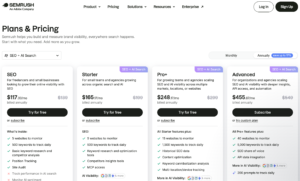
As of August 2026, Semrush lists three main Semrush One tiers:
Starter – $199 per month
Pro+ – $299 per month
Advanced – $549 per month
Annual billing reduces the effective monthly prices to approximately $165.17, $248.17, and $455.67 respectively.
Starter currently includes five monitored websites, 500 tracked SEO keywords, 50 AI prompts tracked daily, one AI brand-performance domain, and 300 AI visibility reports per day.
Pro+ expands the limits to 15 websites, 1,500 keywords, and 100 AI prompts, while Advanced increases them to 40 websites, 5,000 keywords, and 200 AI prompts and adds more advanced capabilities such as API data integration.
Semrush SEO Toolkit Pricing in 2026
If you do not need the full Semrush One AI package, Semrush still offers its standalone SEO Toolkit.
Current monthly prices are:
Pro – $139.95 per Month
The entry-level professional SEO plan is aimed primarily at freelancers, small businesses, and SEO beginners.
Guru – $249.95 per Month
Guru is intended more for growing agencies and teams that require higher limits.
Business – $499.95 per Month
Business is designed for established agencies and larger organizations requiring significantly more capacity.
Semrush’s current official comparison lists annual effective monthly pricing of approximately $117.33 for Pro, $208.33 for Guru, and $416.66 for Business.
The entry SEO plan currently supports five monitored websites and 500 tracked keywords.
Because SaaS pricing can change, check the official Semrush pricing page before subscribing.
Is There a Free Semrush Plan?
Yes.
Semrush currently provides a limited free option designed to let people explore the platform.
The current pricing page lists a free tier with one demo project and 10 reports per day across core tools.
This can be useful if you only need occasional research.
Professional SEO work, however, will quickly exceed the free limits.
Does Semrush Have a Free Trial?
Yes, for several primary toolkits.
Semrush currently states that SEO, Traffic & Market, Social, Content, Local, and Advertising toolkits offer seven-day trials. Semrush One also has a trial option, while the standalone AI Visibility Toolkit currently provides a free demo report rather than a standard trial.
Always verify trial terms when signing up because promotions can change.
Semrush Content Tools in 2026
Semrush has also expanded its content capabilities.
Its Content Toolkit currently costs $60 per month and includes content ideas, SEO briefs, content optimization, AI-assisted writing, brand voices, and WordPress publishing.
This means Semrush is increasingly trying to cover the full workflow:
Research a keyword.
Understand competitors.
Build a brief.
Create or optimize content.
Monitor rankings.
Analyze backlinks.
Measure AI visibility.
That is appealing if you prefer an integrated marketing stack.
However, it can also make the platform feel overwhelming.
Not everyone needs every toolkit.
Semrush for Local SEO
Semrush can also help businesses that depend on local organic search.
Position Tracking supports geographic targeting down to very specific locations, including postal-code-level tracking.
That can be useful for businesses targeting searches such as:
“personal injury lawyer Dallas”
“dentist Chicago”
“kitchen remodeling Sacramento”
“gym near me”
National ranking data would not necessarily tell you what customers in an individual city actually see.
Localized tracking can provide a much more accurate picture.
Semrush for Link Building
For someone doing link building, Semrush can be useful at several stages.
You can use it to:
Research competitor backlinks.
Identify linking domains.
Find backlink gaps.
Review authority metrics.
Analyze anchors.
Find new and lost links.
Study highly linked competitor pages.
Investigate which publishers AI systems cite.
Semrush is even incorporating AI-citation information into parts of its backlink and PR workflows, allowing marketers to research outlets that AI platforms reference.
This is particularly interesting in 2026.
A relevant editorial mention may contribute not only to conventional SEO authority and referral visibility but also to the wider online source ecosystem AI systems rely on.
For the outreach-management side of link building, however, dedicated tools can still make more sense. You can see the difference in my BuzzStream Review and Pitchbox Review.
Semrush vs. Ahrefs
Semrush and Ahrefs are probably two of the most frequently compared professional SEO platforms.
Both provide strong functionality around:
- Keyword research
- Competitors
- Backlinks
- Rankings
- Content opportunities
- Website analysis
Ahrefs has traditionally been particularly popular with backlink-focused SEOs.
Semrush has a broader marketing-tool ecosystem and is pushing aggressively into AI visibility alongside traditional SEO.
The better choice depends on your workflow.
If your day revolves primarily around competitor backlinks, Ahrefs may feel particularly natural.
If you want keywords, SEO campaigns, technical audits, advertising research, content, local marketing, and AI visibility within one broader environment, Semrush may offer more breadth.
For a closer look at Ahrefs, read my Ahrefs Review.
Semrush vs. Moz
Semrush is generally a broader platform than Moz.
Both provide:
- Keyword research
- Rank tracking
- Backlinks
- Competitive analysis
- Site auditing
- Proprietary authority metrics
Moz may feel simpler to someone who primarily wants core SEO research.
Semrush offers a much larger ecosystem and more advanced competitive and AI-search functionality, but that breadth also creates more complexity.
You can compare the other platform in my Moz Review 2026.
Semrush vs. Search Atlas
Search Atlas represents a newer generation of SEO platforms with substantial emphasis on AI-assisted workflows and automation.
Semrush has a much longer-established data ecosystem and broader marketing feature set.
Search Atlas may appeal to users who prioritize newer automated SEO workflows, while Semrush may make more sense for marketers who want a deep traditional SEO dataset combined with increasingly advanced AI visibility features.
I cover Search Atlas separately in my Search Atlas Review.
Semrush Pros and Cons in 2026
Semrush Pros
Extremely broad SEO feature set
Keyword research, competitor analysis, backlinks, rank tracking, auditing, content research, and reporting can all be handled within the platform.
Large keyword database
Semrush currently reports more than 28 billion keywords across 142 regional databases.
Strong competitor research
The platform makes it easy to study competitors’ keywords, links, ranking gaps, and visibility.
Good backlink tools
Backlink Analytics and Backlink Gap provide substantial data for link prospecting and competitor research.
Powerful rank tracking
Position Tracking now covers traditional and AI-powered search environments, including Google, ChatGPT Search, and Google AI Mode.
AI visibility is becoming a serious part of the platform
Semrush is not treating AI search as a minor add-on. It now provides dedicated prompt, brand, competitor, citation, and visibility tracking functionality.
Useful for agencies
Higher-tier plans can support multiple websites, client reporting, competitive research, and more complex campaigns.
Semrush Cons
It is expensive
$139.95 per month is already a meaningful expense for a freelancer or small business, and agency-level plans rise to $249.95 or $499.95 per month. Semrush One begins at $199 monthly.
The interface can feel overwhelming
Semrush includes so many tools that new users may not immediately know which reports actually matter.
AI features can increase the cost
Businesses wanting serious SEO and AI prompt tracking may need Semrush One or a separate AI Visibility subscription rather than simply using the basic SEO plan.
You probably will not use every tool
A freelancer primarily doing link building may never touch large parts of the advertising, social, or local ecosystem.
Third-party metrics still require judgment
Authority Score, keyword difficulty, toxicity scores, and other metrics can help analysis but should not replace manual evaluation.
Who Is Semrush Best For in 2026?
SEO Professionals
Semrush makes sense for people who regularly perform keyword research, competitor analysis, audits, backlink analysis, and ranking monitoring.
Agencies
Agencies may get significant value because the software can support numerous parts of client SEO work within one ecosystem.
Content Marketers
Keyword research, content gaps, competitor analysis, and optimization features can support editorial planning.
Link Builders
Backlink Analytics and Backlink Gap are useful for discovering relevant websites and understanding competitor link strategies.
Small Businesses Serious About SEO
A business actively investing in organic search may benefit from having a professional SEO platform rather than relying entirely on free tools.
Brands Investing in AI Search Visibility
Semrush One becomes particularly interesting for organizations that want to understand both traditional rankings and how they appear across AI platforms.
Who Probably Does Not Need Semrush?
Semrush can be overkill for a small website owner doing occasional SEO research.
If you publish a few articles each year and check keywords once every couple of months, a $139.95 monthly subscription may be difficult to justify.
Likewise, if you already pay for Ahrefs and use almost all of its capabilities, adding Semrush may create significant overlap.
Before subscribing, ask:
Which Semrush features am I realistically going to use every week?
If your answer is only one or two tools, there may be a less expensive alternative.
Is Semrush Good for Beginners?
Yes, but expect a learning curve.
Semrush gives beginners access to a lot of valuable information, but the amount of data can become distracting.
A new SEO practitioner might see:
Keyword Difficulty
Authority Score
Search volume
Traffic estimates
Toxicity Score
SERP features
Backlink gaps
Keyword gaps
AI visibility
and assume every number requires immediate action.
It does not.
Start with the fundamentals.
Understand your audience.
Find relevant keywords.
Create useful pages.
Fix major technical problems.
Build genuine authority.
Track results.
Then use more advanced reports as your strategy becomes more sophisticated.
Can Semrush Help With AI SEO?
Yes, and this is one of the areas where Semrush has changed most significantly in 2026.
Its AI Visibility products can currently monitor mentions, citations, competitive visibility, prompts, and brand performance across major AI search systems.
Semrush’s own 2026 research is increasingly focused on this area. Its expanded AI Visibility Index was published in June 2026 using an analysis based on 126 million real-user prompts, demonstrating how heavily the company is investing in AI-search measurement.
I would still avoid thinking about “AI SEO” as completely separate from traditional SEO.
The fundamentals overlap heavily.
Strong content.
Relevant mentions.
Authority.
Brand recognition.
Reliable information.
Useful pages.
Technical accessibility.
All of those can matter across different discovery environments.
Is Semrush Worth It in 2026?
Semrush is still one of the most capable SEO platforms available in 2026.
Its traditional strengths remain intact:
Keyword research.
Competitor analysis.
Backlinks.
Rank tracking.
Technical auditing.
Content research.
What makes the platform more interesting now is that it is actively adapting those capabilities to AI-powered discovery.
Semrush’s current positioning is increasingly about visibility everywhere search happens, rather than only traditional Google rankings. Its current paid options reflect that distinction: the SEO Toolkit remains available for conventional SEO workflows, while Semrush One combines SEO with more advanced AI visibility tracking.
The main disadvantage is price.
For a casual blogger, Semrush may be more software than necessary.
For a professional SEO, agency, content marketer, link builder, or business where organic search contributes directly to revenue, the amount of data available can justify the cost.
The important thing is not buying Semrush because it has the longest feature list.
Buy it if those features actually help you make better decisions.
If I were evaluating Semrush in 2026, I would think about it this way:
If I only need occasional keyword research, I probably do not need it.
If I regularly analyze competitors, backlinks, keywords, technical problems, rankings, content gaps, and client websites, the SEO Toolkit becomes much easier to justify.
And if I also need to understand whether my brand is being mentioned, cited, or recommended across ChatGPT, Gemini, Perplexity, Google AI Mode, and related AI experiences, Semrush One becomes much more interesting.
Frequently Asked Questions
What is Semrush?
Semrush is a digital marketing and SEO platform offering keyword research, competitor analysis, backlink tools, site auditing, rank tracking, content research, and AI visibility monitoring.
How much does Semrush cost in 2026?
The standalone Semrush SEO Toolkit currently costs $139.95 per month for Pro, $249.95 for Guru, and $499.95 for Business. Semrush One currently starts at $199 per month and adds deeper AI visibility capabilities.
Is Semrush free?
Semrush currently offers a limited free option with one demo project and 10 reports per day across core tools.
Does Semrush offer a free trial?
Semrush currently provides seven-day trials for several major toolkits, including SEO, and offers a Semrush One trial.
Is Semrush good for keyword research?
Yes. Semrush provides Keyword Magic and related keyword research tools, and currently reports a database exceeding 28 billion keywords across 142 geographic databases.
Is Semrush good for backlink research?
Yes. Semrush provides backlink analysis, referring-domain research, Backlink Gap, authority metrics, and competitor backlink analysis.
Can Semrush find competitor backlinks?
Yes. You can enter competing domains to examine their backlink profiles and identify domains linking to them.
Can Semrush track Google rankings?
Yes. Position Tracking monitors daily rankings and supports location and device-specific monitoring.
Can Semrush track AI search?
Yes. Semrush currently provides tracking across AI search experiences through its AI Visibility products and parts of Position Tracking, including support for ChatGPT Search and Google AI Mode.
What is Semrush One?
Semrush One combines the traditional SEO Toolkit with the AI Visibility Toolkit, adding features such as custom AI prompt tracking, AI citations, mentions, competitor analysis, and brand-performance monitoring.
Is Semrush good for link building?
Yes, particularly for research. Backlink Analytics and Backlink Gap can help discover websites linking to competitors and identify potential outreach opportunities.
Is Semrush better than Ahrefs?
Neither is automatically better for every user. Ahrefs is particularly popular for backlink and competitor research, while Semrush offers a broader digital-marketing ecosystem and increasingly deep AI-search capabilities. Read my Ahrefs Review if you want to compare the two.
Is Semrush worth paying for in 2026?
Semrush can be worth paying for if keyword research, competitor analysis, backlinks, auditing, rank tracking, and search visibility are regular parts of your work. Users who need both traditional SEO and AI visibility may find Semrush One particularly relevant in 2026.




[…] Tools such as Semrush can help identify these opportunities. I cover the platform’s keyword and competitor research capabilities in my SEMRUSH Review 2026. […]
[…] example, my SEMRUSH Review 2026 and Ahrefs Review 2026 cover tools designed specifically for SEO research rather than […]