
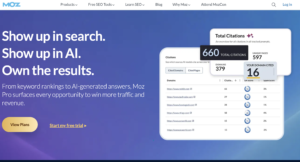

SEO in 2026 looks different from SEO only a few years ago.
Ranking in traditional Google search results still matters, but marketers are now also paying attention to AI Overviews, ChatGPT, Gemini, Perplexity, brand mentions, topical authority, and how often their businesses appear across different search experiences.
At the same time, the fundamentals have not disappeared.
You still need to understand:
- What your audience searches for
- Which keywords your competitors rank for
- Who links to competing websites
- Whether technical problems are affecting your site
- How your rankings change over time
- Whether your authority is growing
- How your brand compares with competitors
That is where SEO platforms such as Moz still have a role.
Moz is one of the longest-established names in SEO software. It is particularly well known for Domain Authority, but Moz Pro in 2026 goes considerably further than a simple authority score.
It includes keyword research, backlink analysis, rank tracking, site crawling, competitive research, on-page optimization, reporting, Brand Authority, and newer functionality aimed at understanding visibility as search becomes increasingly influenced by AI.
So, is Moz still worth paying for in 2026 when tools such as Ahrefs, Semrush, Search Atlas, and newer AI-focused platforms are competing for the same users?
In this Moz Review 2026, I will look at the current features, pricing, strengths, weaknesses, AI capabilities, keyword research, backlinks, Domain Authority, and the types of users who are most likely to get value from Moz Pro.
What Is Moz?
Moz is an SEO software company that provides tools for researching, monitoring, and improving organic search visibility.
Its main professional SEO platform is Moz Pro.
Moz Pro brings several common SEO tasks into one platform, including:
- Keyword research
- Keyword rank tracking
- Backlink analysis
- Competitor research
- Site crawling
- On-page optimization
- Domain analysis
- SEO reporting
- Brand and authority measurement
Moz also maintains a large collection of educational SEO resources through the Moz Blog, making it more than simply a software provider.
For many SEO professionals, however, Moz remains most recognizable because of Domain Authority, usually shortened to DA.
Domain Authority has become so widely used that website owners and link builders sometimes talk about a website’s DA as though it were an official Google metric.
It is not.
I will explain the distinction later because understanding what Domain Authority does—and does not—measure is important when deciding how useful Moz actually is.
What Is Moz Pro in 2026?
Moz Pro is the company’s all-in-one SEO toolkit.
Rather than paying for separate software for keyword research, backlink analysis, rank tracking, and website crawling, Moz Pro allows users to perform many of those tasks within the same ecosystem.
Its core functionality in 2026 continues to revolve around four major areas:
Keyword intelligence
Finding keywords, estimating difficulty, examining search results, and researching content opportunities.
Link intelligence
Analyzing backlinks, referring domains, anchor text, authority, competitors, and potential link opportunities.
Search performance
Tracking keyword rankings and monitoring how search visibility changes.
Site health
Crawling websites and identifying technical SEO issues.
Moz has also been adding AI-related functionality as marketers begin measuring visibility beyond conventional blue-link rankings. Contemporary 2026 reviews of the platform report Moz AI tools and AI Visibility functionality being introduced alongside its established SEO toolset.
That makes the 2026 version of Moz more relevant than a review focused only on Domain Authority and backlinks would suggest.
Moz Keyword Explorer
Keyword research remains one of Moz Pro’s most useful capabilities.
Moz’s Keyword Explorer helps marketers investigate what people are searching for and evaluate whether those searches represent realistic SEO opportunities.
You can begin with a seed keyword and analyze metrics designed to help answer questions such as:
How often is this searched?
How competitive is it?
What related keywords should I investigate?
What currently ranks?
What type of content does Google appear to favor?
Is this keyword potentially worth targeting?
Keyword Explorer provides metrics including search volume, Keyword Difficulty, Organic CTR, related terms, SERP information, and Moz’s Priority metric.
In 2026, Moz Keyword Explorer continues to be recognized for being relatively straightforward to use while providing search volume, difficulty information, SERP analysis, and keyword suggestions.
Moz Keyword Difficulty
Moz’s Keyword Difficulty score attempts to estimate how difficult it may be to rank organically for a particular search.
This can be useful when comparing potential content opportunities.
Suppose you discover:
Keyword A
10,000 estimated monthly searches
Very high difficulty
Keyword B
1,700 estimated monthly searches
Moderate difficulty
A beginner may automatically choose Keyword A because it has more search volume.
That is not always a good decision.
If your website has virtually no realistic chance of reaching the first page for Keyword A, those 10,000 searches may provide no traffic at all.
Ranking in the top few positions for the smaller query could generate considerably more traffic.
Keyword Difficulty helps you compare those situations.
However, it should not make the decision for you.
Search Intent Still Matters More Than a Keyword Score
One thing no SEO platform can completely replace is understanding search intent.
Consider these searches:
“What is email outreach?”
“best cold email software”
“Smartlead pricing”
All three involve email outreach, but the people searching them are at very different stages.
The first is informational.
The second indicates commercial investigation.
The third may indicate someone who is already evaluating a particular product.
A good SEO strategy should consider what the searcher wants rather than simply choosing whatever keyword shows the largest number inside an SEO tool.
This is why keyword research tools should support human judgment rather than replace it.
I discuss this broader approach to combining traditional SEO research with newer technology in my guide to the AI SEO tools I use.
Moz Domain Authority in 2026
Domain Authority remains Moz’s best-known proprietary metric.
DA scores websites from 1 to 100 and is intended to estimate how likely a domain is to rank relative to other domains.
Higher scores generally correspond with stronger overall link profiles and established domains.
For example, an established national publication may have a much higher DA than a small website launched six months ago.
This makes Domain Authority useful for comparative analysis.
But there is one important point every website owner should understand:
Domain Authority Is Not a Google Ranking Factor
Google does not use your Moz Domain Authority score when determining search rankings.
DA belongs to Moz.
It is a predictive third-party metric based on Moz’s own link data and methodology.
So if someone says:
“Google loves this website because it has DA 70.”
that statement is misleading.
Google does not see a Moz DA 70 and award the website additional ranking points.
The better way to use DA is:
“My competitor’s domain has considerably stronger authority metrics than mine.”
or:
“This potential publisher has a stronger link profile than most sites in this niche.”
That is much more useful.
Should You Use Moz DA for Link Building in 2026?
Yes—but not by itself.
Domain Authority can be helpful when evaluating link prospects, but obsessing over DA can result in poor link-building decisions.
Imagine two websites.
Website A
DA 71
Very little topical relevance
Generic content
Links to almost every industry imaginable
Website B
DA 39
Directly relevant to your niche
Real editorial content
Relevant organic traffic
Strong audience alignment
I would not automatically choose Website A simply because its DA is higher.
When evaluating a potential link, consider:
- Topical relevance
- Organic visibility
- Content quality
- Editorial standards
- Website history
- Indexation
- Audience relevance
- Outbound linking behavior
- Placement context
- Traffic quality
DA should be one signal.
It should not become your entire link-building strategy.
That is also why I focus on earning contextual editorial mentions rather than simply chasing arbitrary authority scores in my guide on building industry-related links without placement fees.
Moz Link Explorer
Moz’s Link Explorer is the platform’s primary backlink research tool.
Backlink analysis remains important in 2026 because links can help reveal authority, relationships between websites, competitor strategies, and content that other publishers consider worth referencing.
Link Explorer can help investigate:
- Backlinks
- Referring domains
- Anchor text
- Domain Authority
- Page Authority
- Linking pages
- New links
- Lost links
- Competitor backlink profiles
Moz remains recognized in 2026 as a capable backlink research platform, with Link Explorer providing information about backlink profiles, authority metrics, anchor text, and competitor links.
Using Moz for Competitor Backlink Research
Competitor backlink research is one of the most valuable ways to use an SEO tool.
Suppose three competitors rank above you.
You can investigate which websites link to them.
Perhaps you discover that several industry publications repeatedly link to your competitors but have never mentioned your business.
That gives you something to research.
Do not automatically send:
“Hi, I saw you linked to my competitor. Please link to me too.”
Instead, ask:
Why did they receive the link?
Maybe they created original research.
Maybe they contributed expert insight.
Maybe they published useful statistics.
Maybe the publisher mentioned their product.
Maybe they had a genuine relationship with the writer.
Backlink tools reveal where links exist.
Good link builders investigate why they exist.
That difference matters.
Moz Link Intersect Opportunities
Link intersection research can also be useful.
Imagine:
Site X links to Competitor A.
Site X links to Competitor B.
Site X links to Competitor C.
But Site X has never linked to you.
That pattern can suggest Site X has an established editorial interest in your industry.
This does not guarantee they will link to your website.
But it gives you a much more relevant outreach target than randomly searching the internet for websites.
Once prospects are identified, you still need a separate process for outreach and relationship management.
Moz is primarily an SEO research tool rather than a dedicated outreach CRM.
For that side of link acquisition, see my BuzzStream Review 2026 and Pitchbox Review 2026.
Moz Spam Score
Moz also provides Spam Score.
Spam Score attempts to identify characteristics that occur more frequently among sites Moz has associated with spam.
This can provide another signal when reviewing potential backlinks.
However, the same principle applies here as with Domain Authority.
Do not reject a website automatically because one third-party metric looks unusual.
Actually inspect the site.
Look at:
What does it publish?
Who appears to run it?
Does the content make sense?
Does it rank?
Is it indexed?
Does every article contain commercial links?
Does it publish unrelated subjects?
Does it appear to have a real audience?
Metrics are useful for identifying things that deserve further investigation.
They should not replace investigation.
Moz Rank Tracking
Moz Pro includes rank tracking so users can monitor important keyword positions over time.
For example:
January: Position 27
March: Position 15
May: Position 9
August: Position 5
That provides a simple way to see whether an SEO campaign is moving in the right direction.
Rank tracking can also expose problems.
Suppose one of your most valuable keywords moves from position 4 to position 18.
That deserves attention.
Possible explanations could include:
- Google algorithm changes
- Competitor improvements
- Search intent changes
- Content becoming outdated
- Lost backlinks
- Technical problems
- Internal linking changes
- SERP layout changes
Moz can tell you the ranking moved.
It cannot automatically tell you the full reason why.
That still requires analysis.
Moz Site Crawl
Technical SEO can quietly prevent otherwise strong pages from performing.
Moz Pro includes Site Crawl functionality for identifying technical issues across websites.
A crawler can help locate problems involving areas such as:
- Broken links
- Redirects
- Missing tags
- Duplicate pages
- Crawlability
- Metadata
- Website structure
- Page-level SEO problems
This becomes particularly valuable as a website grows.
Reviewing a 20-page website manually is possible.
Reviewing 10,000 pages individually is not.
Current 2026 assessments continue to list site auditing and crawl analysis as core Moz Pro capabilities alongside rankings, links, and competitive research.
Moz On-Page Optimization
Moz Pro can also help users review individual pages and identify potential optimization improvements.
On-page SEO can involve:
- Page titles
- Headings
- Keyword relevance
- Content
- Internal links
- Meta descriptions
- Topic coverage
- Page structure
These recommendations can be useful, especially for newer SEO practitioners.
But do not become obsessed with obtaining a perfect tool score.
Your goal is not:
100/100 inside Moz.
Your goal is:
The most useful page for the person performing the search.
SEO tools evaluate signals.
Humans evaluate usefulness.
You need both.
Moz Competitive Research
Moz can also help marketers understand how their website compares with competitors.
Competitive research can reveal:
- Competitor ranking keywords
- Search visibility differences
- Domain authority differences
- Backlink gaps
- Content opportunities
- Competitor link sources
This information can influence both SEO and content strategy.
For example, imagine a competitor receives substantial traffic from 50 informational articles about problems customers experience before buying.
Your website has only commercial service pages.
The lesson is not necessarily:
“Copy those 50 articles.”
The lesson may be:
“They are reaching potential customers much earlier in the buying journey than we are.”
That is a strategic insight.
Brand Authority
Traditional SEO metrics often focus heavily on links and rankings.
But brand strength is becoming increasingly relevant as search becomes more fragmented.
Moz has introduced Brand Authority, another proprietary metric intended to help quantify brand strength and influence.
Brand Authority should be treated similarly to Domain Authority.
It is useful as a comparative Moz metric.
It is not a direct Google ranking factor.
Its relevance becomes more interesting in 2026 because marketers are increasingly concerned with not only:
“Does my page rank?”
but also:
“Does anyone know my brand?”
“Is my company discussed online?”
“Do authoritative sources mention us?”
“Does my brand appear when people research this category?”
That shift connects traditional SEO with broader brand visibility.
Moz and AI Search in 2026
This is one of the areas that should be included in any current Moz review.
SEO in 2026 is not exclusively about ten blue links.
People increasingly discover information through:
- Google AI Overviews
- ChatGPT
- Gemini
- Perplexity
- Other AI assistants
SEO platforms are responding by developing ways to measure visibility in these environments.
Moz has been expanding its AI-related tooling, and 2026 pricing analyses describe AI Visibility as part of Moz’s newer AI product direction, with beta access associated with higher Moz Pro tiers in at least some 2026 plan configurations.
Because these features are evolving quickly, users interested primarily in AI visibility should verify the current availability directly through Moz Pro before selecting a plan.
This is important because traditional rank tracking and AI visibility measurement are different problems.
In Google:
“Where do I rank?”
In AI search:
“Does the system mention my brand?”
“What sources does it cite?”
“How do I compare with competitors?”
“Which prompts trigger my company?”
“What subjects is my brand associated with?”
SEO software will increasingly need to answer both types of questions.
MozBar in 2026
MozBar is Moz’s browser-based SEO toolbar.
It provides quick access to Moz metrics while browsing websites or analyzing search results.
This can be convenient when doing prospect research.
Imagine evaluating 50 websites for potential outreach.
Instead of opening a full SEO report for every domain immediately, MozBar can provide a quick first-pass view of authority-related information.
Then you can investigate promising sites in greater depth.
Again, metrics should be used as filters rather than absolute judgments.
Moz for Link Building in 2026
Moz is useful for link building primarily during the research and analysis stages.
You can use it to:
Analyze competitor backlinks.
Find referring domains.
Compare domain strength.
Examine anchor text.
Discover link gaps.
Identify linked content.
Monitor gained and lost links.
Evaluate prospects.
But Moz does not remove the most difficult part of link building:
Giving someone a legitimate reason to mention your website.
A publisher is unlikely to care that Moz says you need more backlinks.
You still need something worthwhile.
That could be:
- Original research
- Expert insight
- Useful statistics
- A unique resource
- A valuable product
- An interview
- A genuinely relevant contribution
- A better source for an existing article
Moz helps you find opportunities.
Your strategy turns those opportunities into links.
Moz for Content Marketing
Moz can also support content planning.
Keyword Explorer can reveal topics people search for.
Competitor analysis can show which topics already generate visibility.
Backlink analysis can identify which types of content attract citations.
Together, this can help answer:
What should we publish?
What questions are people asking?
Which topics have realistic ranking potential?
What has already worked for competitors?
Which resources attract links?
A good content strategy combines those answers rather than simply exporting 1,000 keywords and sending them to writers.
Moz vs. Ahrefs in 2026
Moz and Ahrefs still overlap substantially.
Both provide functionality around:
- Keywords
- Backlinks
- Competitors
- Rank tracking
- Website research
- SEO opportunities
Ahrefs remains particularly strong for backlink research and competitive analysis, while Moz is attractive for users who like its authority metrics, approachable interface, research tools, and broader educational ecosystem.
TechRadar’s 2026 SEO-tool coverage continues to place both among leading professional SEO platforms, with Moz particularly noted for usability and link analysis.
I use a separate article to go deeper into Ahrefs, so you can read my Ahrefs Review 2026 if you are deciding between the two.
The important question is not which brand is more famous.
It is which tool better matches your workflow.
Moz vs. Search Atlas in 2026
Search Atlas represents a newer generation of SEO software compared with Moz.
Both platforms can address areas such as keyword research, backlinks, site optimization, competitor research, and content.
Search Atlas places significant emphasis on automation and newer AI-driven SEO workflows, while Moz has the advantage of an established ecosystem and metrics that have been used throughout the SEO industry for years.
I have covered that platform separately in my Search Atlas Review.
If you are a freelancer or small agency, pricing may also influence the decision.
Do not pay for a tool because it has 200 features if you regularly use only five of them.
Moz Pro Pricing in 2026
Moz Pro currently uses four primary self-service pricing tiers:
Starter – $49 Per Month
The Starter plan begins at approximately $49 per month when paying monthly.
It is targeted mainly at people managing a relatively small SEO workload.
Current 2026 plan comparisons list one tracked site, 50 tracked keywords, and comparatively limited monthly crawling at this tier.
Standard – $99 Per Month
Standard currently costs approximately $99 per month.
It significantly increases usage allowances and is more practical for marketers managing multiple SEO activities.
Medium – $179 Per Month
Medium currently costs approximately $179 per month.
This tier substantially increases tracked sites, tracked keywords, crawl capacity, and research allowances.
It is likely to make more sense for consultants, internal SEO teams, and smaller agencies.
Large – $299 Per Month
Large currently costs approximately $299 per month.
It is designed for heavier professional use and organizations managing a larger number of sites and keywords.
Across several independently updated 2026 sources, Moz Pro’s core monthly pricing is consistently reported as $49, $99, $179, and $299 for Starter, Standard, Medium, and Large.
Annual subscriptions reduce the effective monthly price, with commonly reported annual equivalents around $39, $79, $143, and $239 per month respectively.
Always verify the latest limits and offers on the official Moz Pro pricing page before purchasing because SaaS pricing and feature availability can change.
Does Moz Have a Free Trial in 2026?
Current 2026 pricing references report a 7-day Moz Pro trial, although availability can vary by plan and promotion.
Before starting a trial, check Moz’s current terms directly because trial length and billing requirements can change.
Moz also provides limited free research tools, which can be useful if you only need occasional keyword or authority checks.
Moz Pros and Cons in 2026
Moz Pros
Established SEO platform
Moz has years of experience building search marketing tools and educational resources.
Domain Authority
DA remains one of the most recognized third-party SEO metrics, particularly in link building.
Good keyword research
Keyword Explorer provides useful metrics for researching and prioritizing search opportunities.
Backlink analysis
Link Explorer can be used to research your own links and competitor backlink profiles.
Rank tracking
Important keyword positions can be monitored over time.
Technical SEO tools
Site crawling helps identify problems that could affect search visibility.
Competitor research
Moz makes it possible to compare your search performance and authority with competitors.
Increasing attention to AI search
Moz is evolving beyond purely traditional SEO metrics as AI-driven discovery becomes more important in 2026.
Strong educational ecosystem
The Moz Blog and learning resources make it easier for users to understand the concepts behind the software.
Moz Cons
Starter limits can feel restrictive
The lowest-cost plan is affordable relative to many professional SEO suites, but its usage limits may become restrictive quickly for someone working on several websites.
The cost rises quickly
Moving from $49 to $99, $179, or $299 per month is significant for freelancers and smaller businesses.
Domain Authority is frequently misused
DA is useful, but users sometimes treat it as though it were Google’s own evaluation of a website.
It is not.
Other platforms may be stronger for specialist workflows
If you primarily care about massive backlink datasets, technical crawling, AI content optimization, or outreach automation, a specialized platform may suit you better.
Some newer AI functionality is still evolving
AI search measurement is developing quickly across the SEO industry. Moz’s AI features should therefore be evaluated based on what is actually available in your plan at the time you subscribe.
Who Is Moz Best For in 2026?
SEO Beginners
Moz can be a good learning platform because many of its core concepts are relatively straightforward.
Keyword Difficulty tells you about competition.
Domain Authority helps compare domains.
Link Explorer analyzes backlinks.
Site Crawl identifies technical problems.
Rank Tracking monitors performance.
Freelance SEO Consultants
A freelancer managing several clients can use Moz for research, audits, backlink analysis, rankings, and reporting.
The question is whether the plan limits match the number of clients being managed.
Small Businesses
A business handling SEO internally may appreciate having multiple SEO functions within a single platform.
Content Marketers
Keyword and competitor research can support a more evidence-based editorial strategy.
Link Builders
Link Explorer, Domain Authority, competitor backlinks, and link-intersection research can all help during prospect discovery.
SEO Agencies
Agencies can use Moz, although they will probably need the Medium, Large, or enterprise-level options depending on their workload.
Who Probably Does Not Need Moz?
Someone publishing a handful of articles per year may not need a paid professional SEO platform.
Likewise, if you already have a comprehensive Ahrefs or Semrush subscription and use it extensively, buying Moz as well may create unnecessary overlap.
Before adding another subscription, ask:
What specific problem will Moz solve that my existing tools do not?
If you cannot answer that question, you probably do not need another SaaS subscription.
Is Moz Good for Beginners in 2026?
Yes.
Moz remains one of the more approachable professional SEO platforms.
However, beginners should avoid becoming dependent on proprietary metrics.
A DA 70 website is not automatically excellent.
A Keyword Difficulty score of 20 does not guarantee you can rank.
A site audit warning does not automatically make that issue your highest priority.
The tool provides evidence.
You still need to interpret it.
Developing that judgment is one of the most important parts of becoming good at SEO.
Is Moz Domain Authority Still Relevant in 2026?
Yes, when used correctly.
Domain Authority remains useful for:
- Competitor comparisons
- Backlink prospect research
- Monitoring relative domain strength
- Quickly screening websites
It becomes much less useful when marketers turn it into an objective by itself.
Your business goal should not be:
“Get DA 50.”
Your business goal should be something closer to:
Increase qualified organic traffic.
Generate more leads.
Build genuine authority in your industry.
Earn editorial mentions from trusted sources.
Increase visibility across Google and AI search.
DA can help measure one dimension of that process.
It is not the process itself.
Can Moz Help With AI SEO?
Moz is becoming more relevant to AI-search workflows, but I would not buy it solely for AI visibility without first examining the current feature set.
The AI-search software market is changing extremely quickly in 2026.
Features that are beta today may be completely different six months later.
The broader Moz advantage is that AI-related visibility can sit alongside established SEO information such as:
Keywords
Links
Authority
Competitors
Rankings
Site health
That can make it easier to think about AI search as an extension of broader organic visibility rather than treating it as an entirely separate marketing channel.
Is Moz Good for Link Building?
Moz remains useful for link-building research.
It can help you answer:
Who links to my competitors?
Which websites link to several competitors?
How strong are those domains?
Which competitor pages attract links?
What anchor text is being used?
Where have links recently been gained or lost?
But the platform cannot automatically create editorial relationships.
You still need outreach.
You still need a reason for someone to mention you.
And you still need to evaluate prospects manually.
That is why tools such as Moz and outreach platforms serve different purposes.
Moz helps uncover the opportunity.
Your outreach strategy determines whether anything happens with it.
Is Moz Worth It in 2026?
Moz remains a legitimate professional SEO platform in 2026.
It would be inaccurate to think of it only as the company that created Domain Authority.
Moz Pro now combines keyword research, backlink analysis, site crawling, rankings, competitive intelligence, authority metrics, reporting, and emerging AI visibility capabilities within one ecosystem. Current 2026 reviews continue to position it among the established professional SEO suites.
Whether it is worth paying for depends on your situation.
If you regularly need to:
Research keywords.
Analyze backlinks.
Investigate competitors.
Track rankings.
Audit websites.
Evaluate link opportunities.
Monitor SEO progress.
Then Moz can consolidate a lot of work.
For someone managing a single small blog, however, a $99 or $179 monthly subscription may be unnecessary.
The Starter plan lowers the cost of entry, but its limits can become restrictive if you begin managing multiple sites.
I would therefore evaluate Moz based on the actual work you perform every month rather than choosing it simply because DA is widely recognized.
In 2026, the strongest reason to consider Moz is that it still covers the core fundamentals of SEO while beginning to adapt to a world where visibility extends beyond conventional Google rankings.
That combination makes it useful for marketers who want to continue tracking traditional SEO without ignoring how search is changing.
Frequently Asked Questions
What is Moz?
Moz is an SEO software platform offering keyword research, backlink analysis, rank tracking, site crawling, competitor research, authority metrics, and other tools designed to improve organic search visibility.
What is Moz Pro?
Moz Pro is Moz’s paid professional SEO suite. It combines research, monitoring, technical SEO, backlink, keyword, and reporting tools within one platform.
How much does Moz cost in 2026?
Moz Pro’s main monthly plans are currently reported at approximately $49 for Starter, $99 for Standard, $179 for Medium, and $299 for Large. Check the official Moz pricing page before subscribing because prices and limits can change.
Does Moz have a free trial in 2026?
Current 2026 plan information indicates Moz Pro offers a 7-day trial under eligible plans or signup configurations. Verify the current terms before signing up.
What is Moz Domain Authority?
Domain Authority is Moz’s proprietary metric for predicting the relative ranking strength of a domain on a scale from 1 to 100.
Is Moz Domain Authority a Google ranking factor?
No. Domain Authority is a Moz metric and is not a ranking factor used directly by Google.
Is Moz still relevant in 2026?
Yes. Moz continues to provide keyword research, backlink analysis, rank tracking, site auditing, authority metrics, competitive research, and newer AI-related functionality.
Can Moz find competitor backlinks?
Yes. Moz Link Explorer can be used to analyze backlinks pointing to competing domains and pages.
Is Moz good for keyword research?
Yes. Keyword Explorer provides search volume estimates, difficulty metrics, keyword suggestions, SERP analysis, and other information that can help evaluate content opportunities.
Is Moz good for link building?
Moz is particularly useful for link research, competitor backlink analysis, Domain Authority comparisons, and discovering potential prospects. It is not primarily a publisher-outreach CRM.
Does Moz track keyword rankings?
Yes. Rank tracking remains one of the core Moz Pro features in 2026.
Can Moz audit a website?
Yes. Moz Pro includes site crawling and auditing tools that help identify technical and on-page SEO problems.
Does Moz offer AI visibility tools in 2026?
Moz has been rolling out AI-related functionality, including AI Visibility capabilities. Current 2026 plan comparisons describe some of this functionality as beta and dependent on subscription level. Users should verify current availability before selecting a plan specifically for AI search tracking.
Which is better in 2026: Moz or Ahrefs?
It depends on your needs. Both offer professional SEO research capabilities. Ahrefs is particularly strong in backlinks and competitive research, while Moz combines established link and keyword tools with well-known authority metrics and an approachable SEO ecosystem. See my Ahrefs Review 2026 for a closer comparison.
Is Moz worth paying for in 2026?
Moz can be worth the cost for marketers, consultants, businesses, and agencies that regularly use keyword research, rank tracking, backlinks, competitor analysis, and site auditing. If you only perform occasional SEO research, the subscription may be harder to justify.




[…] I discuss this same issue with DA in my Moz Review. […]