
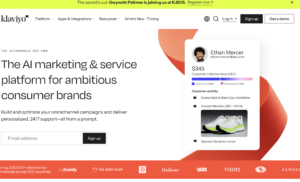

Email marketing platforms have become much more sophisticated than tools for sending newsletters.
For ecommerce and consumer brands in 2026, an email platform may also need to manage customer profiles, behavioral data, automated flows, SMS, WhatsApp, mobile notifications, product recommendations, customer service interactions, revenue attribution, and AI-powered personalization.
Klaviyo has been moving aggressively in this direction.
Rather than describing itself simply as email marketing software, Klaviyo now positions its platform as an autonomous B2C CRM that brings marketing, customer data, analytics, and service together.
That is an important distinction.
You can still use Klaviyo to send a weekly email campaign, but that barely touches what the platform is designed to do.
In this Klaviyo Review 2026, I will look at Klaviyo’s email marketing features, automations, segmentation, SMS and mobile messaging, AI tools, customer data capabilities, integrations, analytics, pricing, advantages, limitations, and who I think will get the most value from using it.
What Is Klaviyo?
Klaviyo is a customer relationship and marketing platform built primarily for businesses that sell directly to consumers.
It is particularly well known among ecommerce brands.
The platform combines customer data with marketing and service functionality so businesses can communicate with customers based on what those customers actually do.
Klaviyo currently supports channels including:
- SMS
- RCS
- Mobile push
- Website experiences
Customer interactions across these channels can be connected to unified customer profiles, allowing businesses to create more personalized campaigns and automated experiences.
For example, instead of sending the exact same promotional email to every subscriber, an ecommerce business could create different messaging for:
Someone who purchased yesterday.
Someone who abandoned a cart.
A customer who has purchased five times.
Someone who has not purchased in six months.
A VIP customer.
A subscriber who repeatedly browses one product category.
That ability to act on customer behavior is where Klaviyo becomes much more powerful than basic newsletter software.
Klaviyo in 2026: More Than an Email Marketing Platform
One of the biggest things to understand in this Klaviyo Review is how significantly the platform has expanded.
Klaviyo now combines:
Marketing
Email, SMS, WhatsApp, RCS, push notifications, forms, and automated campaigns.
Data
Customer profiles, events, segmentation, integrations, predictive insights, and customer history.
Analytics
Campaign performance, attribution, funnel analysis, benchmarks, and revenue measurement.
Service
Customer Hub, Helpdesk, and AI-assisted customer support.
Artificial intelligence
AI-assisted segmentation, personalization, predictive analytics, content creation, customer service, and campaign creation.
Klaviyo’s current platform also supports more than 350 integrations and APIs, allowing businesses to connect ecommerce, loyalty, shipping, advertising, payments, and other technology to customer profiles.
That makes Klaviyo increasingly similar to a complete B2C customer platform rather than simply an email tool.
Who Is Klaviyo Mainly Designed For?
Klaviyo is particularly suited to businesses where customer behavior generates useful data.
That includes:
- Ecommerce stores
- Retail brands
- Subscription businesses
- Consumer product companies
- Beauty brands
- Fashion brands
- Health and wellness businesses
- Restaurants
- Direct-to-consumer brands
- Larger B2C organizations
The platform can technically be used in other situations, but its strongest features make the most sense when customers browse products, place orders, abandon carts, repurchase, subscribe, and interact with a brand across multiple channels.
A service business simply sending one newsletter every month may not need this level of sophistication.
Klaviyo Email Marketing
Email remains one of the core parts of Klaviyo.
Users can create both one-time campaigns and automated email sequences.
A traditional campaign might be:
A Black Friday promotion.
A new product launch.
A weekly newsletter.
A seasonal sale.
An announcement.
Automated emails work differently.
They can be triggered by customer behavior.
For example:
A subscriber joins the email list.
A customer views a product.
Someone adds an item to a cart.
Someone starts checkout but does not finish.
A first-time customer completes an order.
A customer has not purchased for 90 days.
Those events can trigger automated communication without someone manually sending each message.
This type of lifecycle automation is one of the biggest reasons ecommerce businesses use Klaviyo.
Klaviyo Email Builder
Klaviyo includes a drag-and-drop email editor designed to let marketers build emails without manually coding HTML.
Its free plan currently includes basic email templates and the drag-and-drop editor, meaning a business can begin experimenting with email design without paying immediately.
Emails can include elements such as:
- Product blocks
- Images
- Buttons
- Text
- Promotional offers
- Dynamic information
- Recommendations
- Personalized content
Templates can also make recurring campaigns faster.
For example, a retailer could create one standard newsletter structure and reuse it each week rather than redesigning every message from scratch.
Klaviyo Segmentation
Segmentation is one of Klaviyo’s strongest features.
Instead of thinking of your email list as one enormous group, segmentation allows you to divide customers according to their characteristics and behavior.
Possible segments might include:
Customers who purchased within the last 30 days.
People who viewed a product but never purchased.
Customers whose lifetime spending exceeds $1,000.
Subscribers who have not opened an email recently.
People who purchased from one product category.
Customers predicted to make another purchase soon.
VIP customers.
Customers at risk of churn.
Klaviyo segments can update dynamically as customer behavior changes.
This matters because a customer who belongs in your “new subscriber” segment today may become a purchaser tomorrow and should begin receiving different messages.
Klaviyo also provides AI-assisted segmentation, allowing marketers to describe the audience they want in normal language and have AI help create the appropriate segment rules.
Why Segmentation Matters
Imagine running an online skincare store.
You have 50,000 email subscribers.
Sending the same message to everyone might be easy:
“20% off skincare today.”
But Klaviyo allows you to become more specific.
Someone who previously bought acne products could receive information about products that complement that routine.
Someone who purchased an expensive anti-aging product six weeks ago might receive a replenishment message.
A customer who has spent thousands of dollars could receive early access to a new launch.
A new subscriber could receive educational content before receiving a strong sales message.
The larger your customer database becomes, the more valuable this type of segmentation can become.
Klaviyo Flows and Marketing Automation
Automated flows are another major reason businesses choose Klaviyo.
A flow is a sequence of actions triggered automatically by customer behavior or information.
Common examples include:
Welcome Flow
Triggered when someone joins the email list.
A typical sequence might introduce the brand, explain popular products, and eventually provide an incentive to purchase.
Abandoned Cart Flow
Triggered when someone adds a product to their cart but does not complete the purchase.
The sequence might remind them about the product and address common buying objections.
Browse Abandonment Flow
Triggered when someone repeatedly views products without adding them to a cart.
Post-Purchase Flow
Triggered after someone buys.
It could include:
Order information.
Product education.
Cross-sell suggestions.
A review request.
Replenishment reminders.
Win-Back Flow
Designed to reconnect with customers who have not purchased for a specified period.
VIP Flow
Designed to recognize and reward high-value customers.
The advantage is that these sequences continue running automatically after they are created.
That makes Klaviyo particularly useful for businesses trying to increase the value generated from an existing customer list.
Klaviyo SMS Marketing
Klaviyo also supports SMS marketing.
This allows businesses to coordinate text and email campaigns using the same customer data rather than operating completely separate marketing systems.
For example, a customer might receive:
Email announcing a sale.
SMS reminder several hours before it ends.
Email after purchasing with product recommendations.
The benefit is not simply being able to send text messages.
The bigger advantage is coordinating communication across channels.
Klaviyo can use customer preferences and behavioral information to determine how audiences should be segmented across email and mobile messaging.
Klaviyo Changed Mobile Messaging Pricing in 2026
One important 2026 update involves mobile messaging pricing.
On July 13, 2026, Klaviyo moved its mobile messaging system away from the previous credit-based approach toward dollar-based per-message pricing.
Instead of calculating how many credits an SMS or other mobile message consumes, businesses can now see a dollar-based rate based on the channel and region.
Klaviyo also introduced more than 70 mobile plan tiers to create smaller steps between usage levels.
This is worth knowing if you previously read an older Klaviyo review that explains SMS pricing entirely in terms of credits.
That information may now be outdated.
Klaviyo WhatsApp Marketing
Klaviyo’s omnichannel strategy also includes WhatsApp.
For brands operating in countries where WhatsApp is a major customer communication channel, this can be particularly useful.
Businesses can use customer data and segmentation to send WhatsApp campaigns alongside their other Klaviyo communication.
For example:
Product launches.
Limited-time offers.
Order-related updates.
VIP promotions.
Re-engagement campaigns.
Klaviyo’s broader goal is to allow marketers to coordinate these channels around the same customer rather than treating WhatsApp, email, and SMS as separate databases.
Klaviyo RCS
Klaviyo also supports RCS messaging.
RCS can provide richer mobile messaging experiences than conventional SMS, including more interactive content.
Klaviyo announced general availability of RCS as part of its 2026 expansion across messaging channels.
Not every business will need RCS.
But its inclusion shows how Klaviyo is moving toward becoming a broader omnichannel customer communication platform.
Klaviyo Mobile Push
Brands with mobile applications can also use Klaviyo for push notifications.
This gives businesses another channel to incorporate into customer journeys.
A retailer might coordinate:
Email.
Text.
App push notification.
Website personalization.
WhatsApp.
The goal should not be to message customers everywhere simply because you can.
The advantage is having the ability to choose the appropriate channel based on customer preferences and behavior.
Klaviyo Customer Profiles
One of the reasons Klaviyo’s marketing automation can become sophisticated is that the platform builds customer profiles from data collected across integrations and interactions.
A customer profile could potentially contain information involving:
- Email activity
- Website activity
- Product views
- Purchases
- Order values
- Product categories
- Mobile engagement
- Service interactions
- Predicted behavior
Klaviyo’s Data Platform combines these signals into profiles that can be used for segmentation and personalization.
This is fundamentally different from a basic email platform where a contact may consist of only:
Name.
Email address.
Maybe one tag.
The richer customer profile gives marketers much more information to work with.
Predictive Analytics
Klaviyo also uses customer data to provide predictive analytics.
The platform can use historical behavior to make predictions involving areas such as:
- Churn risk
- Future spending
- Customer lifetime value
- Expected purchasing behavior
- Potential next order timing
Klaviyo’s current data platform describes AI-supported prediction of churn, order timing, and spending behavior as part of its customer intelligence capabilities.
These predictions can then influence segmentation.
For example, rather than waiting until a customer has not ordered for one year before calling them “lost,” a brand could identify customers showing signs of churn earlier and attempt to re-engage them.
K:AI
Artificial intelligence is becoming increasingly central to Klaviyo.
Klaviyo refers to its AI layer as K:AI.
K:AI is built into marketing, service, and analytics rather than existing only as a separate writing assistant.
Current AI functionality can support areas such as:
- Predictive analytics
- Content creation
- Segmentation
- Product recommendations
- Send-time optimization
- Channel selection
- Customer service
- Campaign creation
Klaviyo says its AI can use customer data and behavioral information to personalize messaging across different channels.
This is much more interesting than using AI simply to produce email subject lines.
Klaviyo Composer in 2026
One of Klaviyo’s most notable 2026 AI developments is Composer.
Composer is designed to allow marketers to describe a campaign or flow in natural language and have Klaviyo create a starting version.
For example, someone might ask for:
A re-engagement campaign aimed at customers who have not purchased recently.
Composer can then help create the audience and messaging across relevant channels.
Klaviyo announced Composer in March 2026 as part of a broader release containing more than 75 product improvements across marketing, data, analytics, and customer service. At the time of that announcement, Composer was in private beta.
The important part is the direction.
Klaviyo appears to be moving from:
AI helps me write an email
toward:
AI helps me construct the campaign itself.
That could remove a significant amount of repetitive setup work.
Klaviyo Customer Agent
Klaviyo is also expanding beyond marketing with Customer Agent.
Customer Agent is designed to answer customer questions and perform certain service tasks using brand and customer information.
Current capabilities include support around areas such as:
- Order tracking
- Returns
- Exchanges
- Subscription changes
- Loyalty information
Klaviyo expanded these capabilities during 2026 and added controls allowing brands to determine tone, communication style, and when a conversation should be escalated to a human.
This creates an interesting connection between customer service and marketing.
A customer’s support interactions can become part of the same customer data environment used to personalize marketing.
Customer Hub
Klaviyo’s Customer Hub provides a self-service environment where customers can perform activities such as managing their accounts and checking order information.
The current free Klaviyo plan already includes basic Customer Hub functionality such as:
- Account management
- Order tracking
- Order status
- One-click “buy again”
For ecommerce brands, this expands Klaviyo’s role beyond the inbox.
The platform increasingly participates in the customer’s website experience after the email click as well.
Klaviyo Integrations
Integrations are extremely important for a platform like Klaviyo.
Its value depends heavily on customer data.
Klaviyo currently advertises 350+ integrations and APIs across areas including ecommerce, loyalty programs, shipping, advertising, and other parts of the technology stack.
The Shopify integration is particularly important because Klaviyo has long been popular among Shopify merchants.
Other businesses may connect different ecommerce or customer systems.
The goal is to move data into Klaviyo so it can be used for:
Segmentation.
Automation.
Personalization.
Reporting.
Without good customer data, many of Klaviyo’s most sophisticated features become much less valuable.
Klaviyo Analytics
Email marketing metrics can easily become distracting.
It is tempting to focus on:
Open rates.
Clicks.
Unsubscribes.
Those numbers matter, but ecommerce businesses usually care more about revenue.
Klaviyo includes attribution and reporting designed to help connect campaigns and customer interactions to business outcomes.
Its current free plan already includes:
- Campaign reporting
- Email performance metrics
- Revenue attribution
- Engagement reporting
- List growth data
Higher-level analytics can then build on this customer and campaign data.
For ecommerce brands, being able to compare:
“How much revenue did this campaign generate?”
can be considerably more useful than:
“What was the open rate?”
Klaviyo Benchmarks
Klaviyo also publishes industry benchmarking data.
Its 2026 email marketing benchmarks are based on performance data across more than 183,000 Klaviyo customers, according to the company’s current benchmark materials.
This can provide useful context.
For example, suppose your email open rate is 42%.
Is that good?
Without knowing how similar brands perform, the number is difficult to evaluate.
Benchmarks can help you compare campaign metrics with businesses operating in the same or similar categories.
I would still avoid chasing benchmark numbers without considering revenue and customer behavior.
A lower-open-rate email that generates significantly more sales can still be the better campaign.
Klaviyo Free Plan in 2026
Klaviyo currently offers a genuine free plan.
At the time of this Klaviyo Review 2026, the free plan includes:
- Up to 250 active profiles
- Up to 500 email sends per month
- $5 of mobile messaging per month
- 10,000 Composer credits
- Basic email templates
- Drag-and-drop email editing
- AI-powered subject line generation
- Customer segmentation
- Campaign reporting
- Revenue attribution
- Basic Customer Hub
- Basic Helpdesk
The free plan can remain active indefinitely as long as the account stays within the profile and sending limits.
Email support is currently available to free users for the first 60 days, after which self-service resources remain available.
Klaviyo Paid Pricing in 2026
Klaviyo’s paid pricing is more complicated than a simple:
Basic: $20
Pro: $50
Business: $100
Pricing scales based on factors including the number of active profiles and the channels being used.
Email volume matters.
Mobile usage matters.
Service and AI products can also affect overall cost.
Klaviyo’s official pricing page includes a calculator that allows businesses to build a plan based on their requirements.
Because the price can change substantially as a customer list grows, I recommend checking the current Klaviyo pricing rather than relying on an old screenshot from a third-party review.
This is particularly important in 2026 because Klaviyo changed mobile messaging pricing in July.
Does Klaviyo Become Expensive?
It can.
This is probably one of the most important limitations to understand.
A new ecommerce store with 200 subscribers can use Klaviyo very cheaply—or even free.
A mature business with hundreds of thousands of customer profiles and heavy email, SMS, WhatsApp, and service usage can spend considerably more.
This means Klaviyo’s cost should be evaluated against the revenue the platform helps generate.
For example:
If Klaviyo costs $500 per month and generates $30,000 in measurable additional monthly revenue, that can be easy to justify.
If it costs $500 per month while your entire store generates $3,000, the calculation looks very different.
The bigger your list becomes, the more carefully you should manage inactive profiles and evaluate whether your automations are producing enough value.
Is Klaviyo Easy to Use?
Basic Klaviyo features are fairly approachable.
Creating a campaign.
Building a template.
Importing contacts.
Creating a basic flow.
These are tasks many marketers can learn relatively quickly.
The learning curve increases when you begin working with:
Advanced segmentation.
Conditional splits.
Predictive data.
Multiple channels.
Complex lifecycle automations.
Custom events.
APIs.
Advanced attribution.
Customer service workflows.
Klaviyo is powerful partly because it contains a lot of functionality.
That same breadth can feel overwhelming to someone who simply wants to send a newsletter once per month.
Klaviyo for Shopify
Shopify stores are one of Klaviyo’s strongest use cases.
An ecommerce integration can provide Klaviyo with data about:
- Customers
- Products
- Orders
- Browsing behavior
- Shopping carts
- Purchases
That information can then drive automations.
For example:
Customer browses product → receives targeted follow-up.
Customer abandons cart → receives cart flow.
Customer orders → enters post-purchase sequence.
Customer becomes inactive → enters win-back campaign.
This ability to connect commerce data with marketing is the main reason Klaviyo is more compelling for ecommerce than a basic newsletter tool.
Klaviyo for WooCommerce
Klaviyo also supports WooCommerce.
Klaviyo specifically expanded its WooCommerce connection to Customer Hub as part of its 2026 product updates.
For WordPress ecommerce businesses, this can provide many of the same lifecycle-marketing advantages available to other online stores.
The quality of your implementation still matters.
A badly configured integration or poorly designed automation will not perform simply because you are using Klaviyo.
Klaviyo for Small Businesses
Klaviyo can work for small businesses, but the business model matters.
A small ecommerce brand may get a lot of value even with a modest audience.
A small accounting firm may not.
The platform becomes more valuable when:
Customers purchase frequently.
Behavior can trigger relevant communication.
Products can be recommended.
Abandoned carts exist.
Customer lifetime value matters.
Repeat purchases are important.
If none of those conditions apply, a simpler email marketing platform may be perfectly adequate.
Klaviyo for Ecommerce
Ecommerce is where I think Klaviyo makes the most sense.
Online stores naturally generate the type of data Klaviyo is designed to use.
Visitors browse.
Customers abandon products.
People buy.
Some customers return.
Others disappear.
Some purchase one product category repeatedly.
Some become VIPs.
These signals create opportunities for automated lifecycle marketing.
The platform allows businesses to respond to those signals much more precisely than simply sending a newsletter to the entire database every Friday.
Klaviyo for B2B Marketing
Klaviyo can technically be used in some B2B situations, but it would not be my first choice for traditional cold prospecting.
There is an important difference between:
Lifecycle marketing
and:
Cold outreach
Klaviyo is designed largely around communicating with customers and subscribers whose behavior you are already tracking.
Cold email software is built around reaching new prospects.
If your objective is contacting potential customers who have never joined your list, see my Smartlead Review instead.
Smartlead is designed specifically around cold email infrastructure, sending accounts, prospecting sequences, and outbound sales.
Klaviyo is better suited to building relationships with an existing customer and subscriber base.
Klaviyo vs. Internal Email Platforms
Klaviyo is also not designed primarily for employee communications.
If you need to send:
HR announcements.
Executive newsletters.
Employee engagement surveys.
Internal communications.
then an internal communications platform may be more appropriate.
My ContactMonkey Reviews 2026 article looks at software built specifically around employee communications, Outlook/Gmail internal email, segmentation, and employee engagement analytics.
Again, these platforms all involve email but solve completely different problems.
Klaviyo Pros and Cons in 2026
Klaviyo Pros
Excellent for ecommerce lifecycle marketing
Behavioral data can trigger highly relevant automated flows.
Strong segmentation
Customer audiences can be created using behavior, attributes, purchasing data, engagement, and predictive insights.
Email and mobile messaging in one platform
Email, SMS, RCS, WhatsApp, and push can work around the same customer information.
Powerful automation
Welcome, cart, browse, post-purchase, replenishment, and win-back flows can run automatically.
Deep customer data
Klaviyo is built around unified customer profiles rather than basic email contacts.
AI is becoming genuinely useful
K:AI extends across segmentation, predictions, personalization, content, customer service, and increasingly entire campaign workflows.
Large integration ecosystem
Klaviyo currently supports 350+ integrations and APIs.
Free plan
Small brands can experiment with the platform before committing to a paid subscription.
Revenue attribution
Ecommerce marketers can connect campaigns more directly to sales rather than relying only on opens and clicks.
Klaviyo Cons
Pricing can increase as your list grows
Large customer databases can make Klaviyo substantially more expensive.
Pricing is not immediately simple
Costs can depend on profiles, email volume, mobile messaging, service products, and other usage.
Can be excessive for basic newsletters
Someone sending one monthly update may never use most of the platform.
There is a learning curve
Advanced flows and segmentation can become complicated.
AI features are evolving quickly
Some newer tools, including Composer, have been rolling out through beta stages during 2026.
Inactive contacts can affect economics
Businesses need to actively manage their customer database rather than allowing unnecessary profiles to accumulate.
Who Is Klaviyo Best For?
Ecommerce Stores
This remains the strongest fit.
Stores can use purchase, browsing, and cart data to create highly targeted lifecycle communication.
Shopify Brands
Deep ecommerce data makes Shopify stores a natural Klaviyo audience.
WooCommerce Stores
WordPress ecommerce businesses can also connect customer and purchase behavior with Klaviyo.
Direct-to-Consumer Brands
Businesses selling directly to consumers can use customer profiles and multiple messaging channels to improve retention.
Subscription Businesses
Renewals, replenishment, churn, and lifetime value create strong opportunities for automated communication.
Retail Brands
Retail businesses operating across digital channels can benefit from unified customer profiles and omnichannel marketing.
Growing Consumer Brands
As customer lists and marketing complexity increase, Klaviyo’s segmentation and automation become increasingly valuable.
Who Probably Does Not Need Klaviyo?
You may not need Klaviyo if:
You send only occasional newsletters.
You have a tiny email list with little behavioral data.
You operate primarily B2B cold outreach.
You need internal employee communications.
Your business rarely receives repeat purchases.
You do not plan to use segmentation or automation.
In those situations, the platform can become more complicated than the marketing problem requires.
Software should reduce complexity.
It should not create unnecessary complexity simply because the feature list looks impressive.
Can Klaviyo Replace a CRM?
Klaviyo now explicitly positions itself as a B2C CRM.
That makes sense when your customer relationships are primarily consumer-based and driven by ecommerce behavior.
Klaviyo can centralize customer profiles, purchase information, marketing engagement, service interactions, and predictions around future behavior.
However, it is not the same type of CRM used by a traditional B2B sales team managing:
Long sales cycles.
Accounts.
Sales representatives.
Opportunities.
Enterprise contracts.
Complex deal stages.
The right CRM depends on the type of customer relationship being managed.
Can Klaviyo Improve Customer Retention?
It can provide the tools to improve retention.
Whether retention actually improves depends on how those tools are used.
For example, Klaviyo can identify a group of customers who may be at risk of churning.
That is useful.
But the business still needs to create a compelling reason for those customers to return.
Likewise, Klaviyo can automatically send a replenishment reminder.
But if the product experience was poor, the reminder probably will not save the relationship.
Technology makes relevant communication easier.
It does not replace having a good product and customer experience.
Is Klaviyo Good for Marketing Automation?
Yes.
Marketing automation is one of the strongest reasons to choose Klaviyo.
The combination of:
Customer data.
Behavioral triggers.
Dynamic segmentation.
Multiple messaging channels.
Product information.
Purchase history.
Predictive analytics.
allows businesses to create highly specific automated customer journeys.
Klaviyo’s own 2026 marketing guidance continues to emphasize automation, measurement, list growth, and coordinated email/SMS programs as core parts of effective lifecycle marketing.
Is Klaviyo Good for AI Marketing in 2026?
Klaviyo has become considerably more interesting from an AI perspective.
Many software products added AI simply by inserting a writing assistant.
Klaviyo is moving deeper.
Its AI capabilities are increasingly tied to actual customer data and marketing workflows.
That includes:
Predicting behavior.
Building customer segments.
Recommending products.
Optimizing timing.
Assisting with messaging.
Supporting customers.
Helping build campaigns.
That is a more useful direction because the biggest marketing challenge is often not writing another paragraph.
It is deciding:
Who should receive the message?
What should they receive?
When should they receive it?
Which channel should deliver it?
What should happen next?
Klaviyo is increasingly using AI to address those questions.
Is Klaviyo Worth It in 2026?
For ecommerce and consumer brands that intend to use automation seriously, Klaviyo remains one of the more compelling platforms available in 2026.
Its value comes from combining several things that would otherwise need to be handled separately:
Email marketing.
SMS.
WhatsApp.
RCS.
Push notifications.
Customer data.
Segmentation.
Automation.
Analytics.
Customer service.
AI.
The platform becomes particularly valuable when your customer database contains enough behavioral and purchase information to create meaningful personalization.
A business with 100,000 customers should not communicate with all of them exactly the same way.
Klaviyo provides the infrastructure to avoid doing that.
The biggest issue is cost.
Pricing grows along with the database and channel usage, so businesses should continuously evaluate whether their campaigns and flows are generating enough revenue to justify the subscription.
For a new store with only a few hundred subscribers, the free plan makes experimentation relatively easy. The current free tier supports up to 250 active profiles and 500 monthly emails.
For a growing ecommerce business, Klaviyo becomes much more interesting because sophisticated automation can potentially generate revenue without requiring someone to manually manage every message.
For a company that only needs basic newsletters, however, much of the platform may go unused.
That is the main conclusion of this Klaviyo Review 2026:
Klaviyo is most valuable when customer data, repeat purchases, automation, and personalization are central to how your business grows.
If that describes your business, the platform deserves serious consideration.
If all you need is a simple way to email a small subscriber list every few weeks, you probably do not need everything Klaviyo has built.
Frequently Asked Questions
What is Klaviyo?
Klaviyo is a B2C customer relationship and marketing platform that combines customer data, email, SMS, WhatsApp, RCS, mobile push, analytics, automation, and customer service capabilities.
What is Klaviyo used for?
Klaviyo is primarily used for customer lifecycle marketing. Businesses can send campaigns, create automated flows, segment customers, personalize communications, analyze marketing performance, and coordinate messaging across multiple channels.
Is Klaviyo free?
Yes. Klaviyo currently offers a free plan for up to 250 active profiles and 500 email sends per month. The plan also includes $5 of mobile messages per month and 10,000 Composer credits.
How much does Klaviyo cost in 2026?
Klaviyo pricing depends on factors including the number of active profiles and messaging usage. Businesses should use the official Klaviyo pricing calculator to determine the current cost for their list size and channels.
Does Klaviyo offer email marketing?
Yes. Email marketing remains one of Klaviyo’s core capabilities and includes campaign creation, templates, automation, segmentation, personalization, and reporting.
Does Klaviyo offer SMS?
Yes. Klaviyo supports SMS and other mobile messaging. In July 2026, Klaviyo changed mobile messaging from its previous credit-based pricing model to dollar-based per-message rates.
Does Klaviyo support WhatsApp?
Yes. WhatsApp is included among Klaviyo’s supported customer messaging channels.
Does Klaviyo have AI features?
Yes. Klaviyo’s K:AI capabilities include predictive analytics, AI-assisted segmentation, content generation, personalization, product recommendations, Customer Agent, and newer campaign-generation functionality.
What is Klaviyo Composer?
Composer is a newer AI agent designed to help create and optimize campaigns and flows from natural-language instructions. Klaviyo introduced Composer in March 2026, initially through private beta.
Is Klaviyo good for Shopify?
Yes. Shopify ecommerce businesses are one of Klaviyo’s major use cases because customer and commerce information can be used for segmentation, personalized marketing, and automated lifecycle campaigns.
Is Klaviyo good for WooCommerce?
Yes. Klaviyo supports WooCommerce, and its 2026 product updates expanded WooCommerce integration with Customer Hub.
Is Klaviyo good for small businesses?
It can be, particularly for ecommerce businesses that expect to use automation and customer behavior data. A very small business that only needs occasional newsletters may find simpler software sufficient.
Is Klaviyo a CRM?
Klaviyo currently positions itself as a B2C CRM that combines customer data, marketing, analytics, and service.
Is Klaviyo good for cold email?
Klaviyo is not primarily designed for cold sales outreach. Businesses wanting to contact new B2B prospects would generally be better served by a dedicated cold email platform. Read my Smartlead Review for an example.
Is Klaviyo good for internal company emails?
That is not Klaviyo’s primary purpose. Organizations sending employee newsletters and internal communications may prefer specialized software such as the platform covered in my ContactMonkey Reviews 2026.
Is Klaviyo worth it in 2026?
Klaviyo can be worth the cost for ecommerce and consumer brands that use segmentation, automated flows, customer data, and multiple communication channels to drive repeat purchases and customer lifetime value. Businesses that require only basic email newsletters may not use enough of the platform to justify the cost.